

If you have been following Malaysian politics since the 2018 general election, you have witnessed a whirlwind of change. Coalitions have formed, collapsed, and reformed. Party hopping became a national sport. The old Barisan Nasional dominance gave way to a more fluid, multi party landscape. But now, as we move through 2026, a question hangs in the air: is Malaysia heading toward a two party system? This idea feels both familiar and foreign. We have seen two party systems work in countries like the United States or the United Kingdom. Yet Malaysia’s racial and regional diversity seems to resist such simplicity. Still, recent moves by major political blocs suggest a gradual consolidation. The Pakatan Harapan Barisan Nasional cooperation, the strengthening of Perikatan Nasional, and the shrinking space for smaller parties all point in one direction. Let’s look at the evidence and what it means for you as a voter.
Malaysia is not yet a two party system, but by 2026 the trend is unmistakable. Political forces are coalescing around two main blocs: the government coalition (Pakatan Harapan plus Barisan Nasional) and the opposition (Perikatan Nasional). A true two party system would require further consolidation, elimination of smaller parties, and electoral reforms. Voters should watch for signs like party mergers and seat negotiations.
What Does a Two Party System Actually Look Like?
A two party system means that two major political parties dominate elections and governance. Minor parties exist but rarely win enough seats to form government or influence policy directly. In Malaysia’s context, this would mean two large coalitions that each function like a single party. Voters would choose between two clear alternatives. This is different from our current multi party coalition system where three or more blocs compete and post election bargaining decides the government.
Countries with two party systems often enjoy stable governance because one party usually secures a majority. But they also face criticism for limiting voter choice and encouraging polarisation. For Malaysia, the question is whether such a system can accommodate our multi ethnic society.
The Current State of Malaysian Politics in 2026
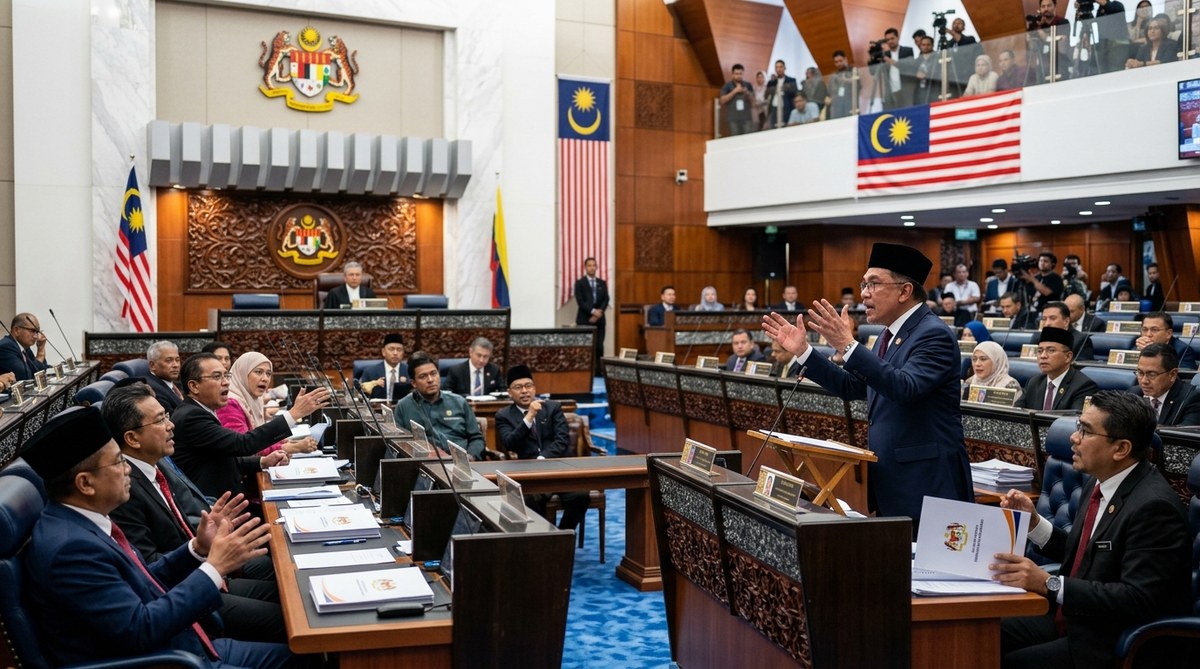
Right now, the political scene is dominated by two broad alliances. On one side, the unity government led by Prime Minister Anwar Ibrahim brings together Pakatan Harapan and Barisan Nasional, plus allies from Sabah and Sarawak. On the other side, Perikatan Nasional under Muhyiddin Yassin has grown stronger after winning many seats in the 2023 state elections.
Smaller parties like Muda, Warisan, and Pejuang struggle to gain traction. The 2022 general election sent a clear signal: voters want stable coalitions, not fragmented parties. Since then, several MPs have crossed over to join the larger blocs, reducing the number of independents and micro parties.
- Electoral trends: In the last few by elections, voters chose candidates from the two main coalitions.
- Party mergers: Talks between PAS and Bersatu within Perikatan Nasional continue, while on the government side, UMNO and PKR have found common ground despite past rivalry.
- Youth support: Younger voters tend to favour either Pakatan Harapan or Perikatan Nasional, with less loyalty to legacy parties.
Signs That Point Toward Two Parties
Several developments in 2026 strengthen the two party hypothesis. The first is the Anti Party Hopping Law, which was fully enforced after the 2022 election. This law reduces the incentive for MPs to jump between blocs, encouraging voters to see each coalition as a stable entity. Second, the Election Commission has discussed moving toward a first past the post system with larger constituencies, which naturally favours two major parties.
Third, the financial and logistical costs of running a campaign have risen. Small parties cannot match the machinery of the big coalitions. They either merge or disappear. Fourth, media coverage increasingly frames politics as a contest between the government and Perikatan Nasional, marginalising third voices.
“If you look at the pattern since 2018, we have moved from a fragmented system to a bipolar one. The next general election, possibly in 2026, will test whether this is a temporary arrangement or a permanent shift,” says Dr. Faridah Hassan, a political analyst at Universiti Malaya.
Challenges Standing in the Way
Despite these signs, a true two party system faces hurdles. Malaysia’s ethnic and religious divisions resist simple two bloc politics. The government coalition itself is an awkward marriage of Pakatan Harapan and Barisan Nasional, which represent different ideologies and ethnic bases. Holding them together requires constant negotiation.
Sabah and Sarawak political parties also complicate the picture. They often demand local autonomy and may not fit neatly into either main bloc. The Parliament could see a third force emerge from East Malaysia if those states feel neglected.
Another challenge is the role of PAS. The party is the largest component of Perikatan Nasional and has a distinct Islamist agenda. If Perikatan Nasional wins, internal tensions between PAS and the more moderate Bersatu could split the coalition, preventing a stable two party system.
Three Possible Outcomes for 2026
- Consolidation into two strong blocs: The government coalition holds together, Perikatan Nasional solidifies, and minor parties fade. The next general election becomes a straight fight between Anwar and Muhyiddin. This scenario would bring Malaysia closest to a two party system.
- Continued fragmentation: The unity government collapses due to internal conflicts, Perikatan Nasional splits, and several new parties emerge. Politics returns to the messy multi party landscape of 2020-2022.
- A hybrid system: Two main blocs dominate, but three or four smaller parties hold the balance of power in Parliament. This would look like the current situation but with fewer players. It is not a true two party system but provides more stability than full fragmentation.
Each outcome depends on the choices of party leaders and voters in the coming months.
How Voters Can Prepare for the Shift
Whether Malaysia moves toward two parties or not, you can take steps to stay informed and engaged.
- Follow reliable political analysis, not just social media gossip. Read outlets like The Malaysian Times for balanced coverage.
- Attend local ceramah or town hall sessions to hear directly from candidates.
- Register to vote and check your polling station early. The Election Commission’s website has updated information.
- Understand the policies of each coalition, not just their personalities. Issues like cost of living, education, and healthcare matter more than partisan loyalty.
Younger voters, in particular, have a chance to shape the future. Your support for certain parties can push them toward moderation or extremism. As The Role of Youth in Shaping Malaysia’s Political Future argues, young Malaysians are already voting in higher numbers and demanding accountability.
Expert Perspective: Why This Matters for Governance
A two party system can bring clarity. Voters know who to credit or blame. Governments can pass laws more easily without endless coalition talks. But it can also reduce representation for minority communities. Malaysia’s unique demographics require careful balancing.
| Aspect | Two-Party System | Multi-Party Coalition |
|---|---|---|
| Government stability | Usually high, single party majority | Often fragile, depends on deals |
| Voter choice | Limited to two options | More parties, more choice |
| Minority representation | Can be overlooked if parties ignore small groups | Smaller parties give voice to minorities |
| Policy consistency | Clear mandate, less compromise | Frequent policy reversals due to horse trading |
The table above compares the two models. For Malaysia, the ideal might be a two party system where both coalitions are broad enough to include all races and regions.
Preparing for Malaysia’s Political Future
Whatever happens by the end of 2026, one thing is clear: Malaysia’s political system is maturing. The chaos of 2020-2022 forced parties to consolidate. Voters now expect stability and performance. If the two party trend continues, you will see simpler elections but also more intense competition. Keep your eyes on the next general election, which could be the most defining vote in a generation.
Stay curious, stay engaged. Read analysis from trusted sources, discuss politics with friends, and always vote based on what benefits your community and the nation. The future of Malaysia’s democracy is in your hands.





Leave a Reply