
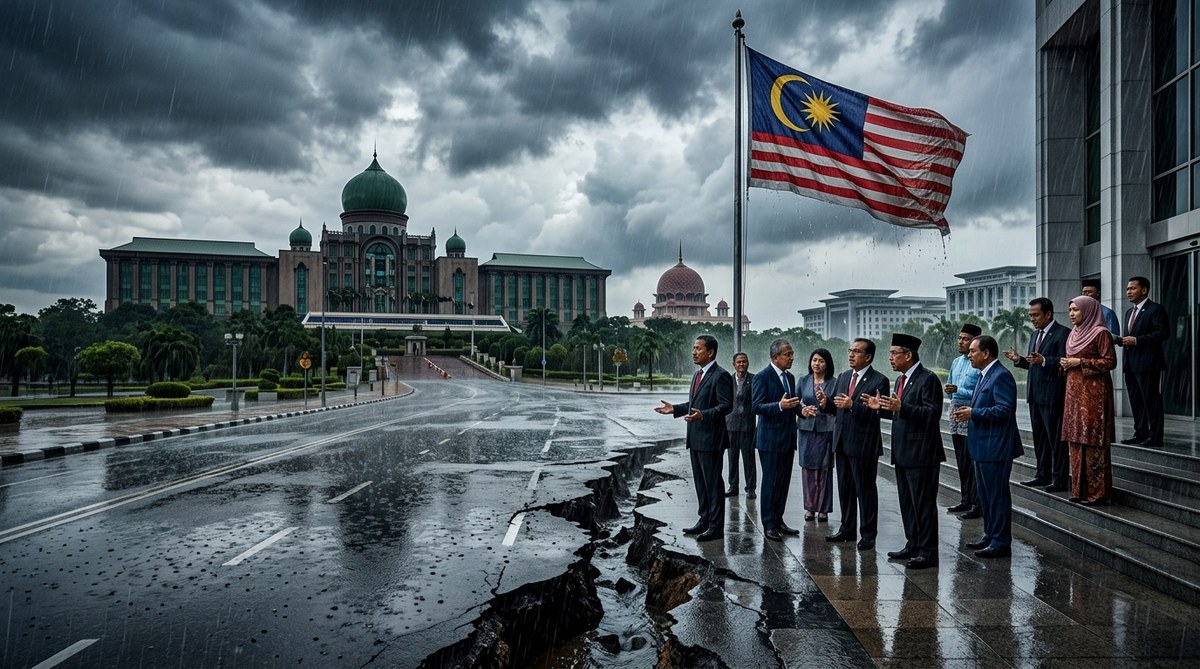
The northeast monsoon arrived in earnest this year, and with it came more than just floodwaters. As rivers swelled across Kelantan, Terengganu, and Pahang, a different kind of pressure began building in Putrajaya. The 2026 monsoon season is not merely a weather event. It is a political stress test. Every delayed relief truck, every disputed evacuation order, and every closed school becomes a bargaining chip in a fragile coalition government. For those watching Malaysian politics, the rain carries signals that are impossible to ignore.
The 2026 monsoon has become an unexpected political battlefield in Malaysia. Federal-state coordination failures, delayed disaster funding, and blame games between coalition partners are exposing deeper cracks in Putrajaya’s unity. Understanding how seasonal climate events trigger political disputes helps analysts predict shifts in governance and policy ahead of the next general election.
When the Sky Opens, the Blame Game Begins
The monsoon season in Malaysia typically runs from November to March. But in 2026, the political fallout started before the first flood warning was issued. MetMalaysia had predicted above-average rainfall due to a weak La Nina pattern. State governments in the east coast, particularly those held by opposition parties, began pre-positioning criticism. They accused the federal government of underfunding drainage infrastructure and delaying the release of disaster relief allocations.
This is not new. What is different in 2026 is the fragility of the coalition in Putrajaya. The unity government, which brings together former rivals under a power-sharing arrangement, is held together by a thin parliamentary majority. Every crisis tests the loyalty of component parties. When a flood hits a constituency held by a backbencher from a different coalition partner, the response must be coordinated. But coordination has been patchy.
In early December, the Menteri Besar of Kelantan publicly stated that federal救援 teams arrived 48 hours late to several districts. The Prime Minister’s office fired back with data showing that federal assets had been deployed before the state requested them. This public spat, played out in the media and on social platforms, is exactly the kind of fracture that opposition parties are using to question the government’s competence.
Three Ways the Monsoon Is Reshaping Political Dynamics
The impact of the monsoon on Malaysian politics can be broken down into three clear areas. Each one reveals a different fault line.
-
Federal-State Relations. States controlled by Perikatan Nasional, like Kelantan and Terengganu, have used flood response as a platform to demand greater autonomy. They argue that Putrajaya is slow because it does not understand local terrain. This has reignited debates about the distribution of power under the Federal Constitution. The federal government counters that disaster management is a national responsibility and that states must follow standard operating procedures.
-
Coalition Trust. Within the unity government, parties like UMNO and DAP have different priorities. UMNO leaders in flood-prone areas want direct cash payouts to victims. DAP leaders, representing urban constituencies, push for long-term infrastructure spending. These disagreements delay cabinet decisions. When the National Disaster Management Agency (NADMA) announced a new flood relief fund in mid-December, it took three cabinet meetings to agree on the amount. That delay was noticed by voters.
-
Opposition Strategy. Perikatan Nasional has turned every flood event into a campaign video. They film themselves wading through floodwaters, handing out supplies, and criticizing the government’s response. This is not just humanitarian work. It is political branding. The opposition knows that the 2026 monsoon will be fresh in voters’ minds when the next election is called.
A Practical Guide to Tracking Monsoon Politics
For analysts and journalists covering this intersection, there are specific signals to watch. Here is a numbered list of practical steps to monitor how the monsoon is testing Putrajaya.
-
Track the NADMA daily situation reports. Compare the timestamps of state requests versus federal deployments. Any gap longer than 24 hours will be used as political ammunition.
-
Follow the social media accounts of Menteri Besar in Kelantan, Terengganu, and Pahang. They often post real-time complaints before official channels do.
-
Monitor parliamentary questions filed during the sitting period. Opposition MPs will ask specific questions about flood relief budgets and response times. The answers reveal where the government is vulnerable.
-
Watch for cabinet leaks. When a minister criticizes a state government anonymously, it signals internal coalition friction.
-
Check the websites of local news portals in the east coast. They often report on ground-level dissatisfaction that national media miss.
Key Players and Their Positions
To understand the political impact, it helps to know who is saying what. The table below summarizes the main actors and their current stance on monsoon management.
| Actor | Position | Political Risk |
|---|---|---|
| Prime Minister’s Office | Emphasizes federal coordination and data-driven response | Vulnerable to accusations of being out of touch with ground realities |
| Kelantan State Government | Demands more autonomy and faster federal aid | Risks being seen as politicizing disaster for electoral gain |
| NADMA | Operates as technical body but faces political pressure | Neutrality questioned when delays occur |
| Opposition Parties | Use flood response to attack government competence | Must balance criticism with offering constructive solutions |
| Civil Society Groups | Push for transparency in disaster fund allocation | Often caught between state and federal narratives |
What Experts Are Saying
Political scientist Dr. Faridah Ahmad from Universiti Malaya offered a clear perspective on this dynamic.
The monsoon has always been a political event in Malaysia. But in 2026, it is different because the government cannot afford any major mistakes. A single flood-related scandal could shift the balance of power in parliament. Every minister knows this, and that is why you see so much finger-pointing. The problem is that finger-pointing does not move water out of people’s homes.
Her observation points to a deeper issue. When political survival takes priority over disaster response, the public suffers. And the public remembers.
Why the 2026 Monsoon Is Different from Previous Years
Some analysts argue that every year is the same. Floods come, politicians blame each other, and life goes on. But 2026 has unique factors that make the stakes higher.
- The unity government is in its second year. Coalition fatigue is real. Smaller parties are looking for reasons to assert their relevance.
- The cost of living crisis has not eased. Voters are already angry. A slow flood response can push them to support the opposition.
- Social media has amplified every complaint. Videos of flooded homes go viral within hours. The government cannot control the narrative the way it could a decade ago.
- Climate change is making monsoons less predictable. Traditional flood maps are becoming outdated. This catches both federal and state agencies off guard.
For a deeper look at how these shifts affect governance, you can read our analysis on how Malaysia’s political landscape will evolve in 2026.
Common Mistakes in Covering Monsoon Politics
For journalists and policy watchers, there are pitfalls to avoid. Here is a bulleted list of common errors.
- Treating flood response as purely a technical issue. It is always political.
- Ignoring state-level politics. The real battles happen in state legislative assemblies, not just in parliament.
- Focusing only on the east coast. Floods in Selangor and Johor also carry political weight, especially in marginal seats.
- Assuming that disaster funding is non-controversial. Every ringgit allocated is scrutinized by coalition partners.
- Overlooking the role of the civil service. NADMA and the district offices are where policy meets reality. Their effectiveness or lack thereof becomes a political weapon.
The Role of Budget 2026 in Shaping the Narrative
The monsoon season arrived just weeks after the tabling of Budget 2026. That is not a coincidence. The budget included a RM2 billion allocation for flood mitigation projects. But opposition leaders pointed out that much of that money is for projects that will take years to complete. It does nothing for the floods happening right now.
This has created a political problem for the government. They can point to the budget as proof of commitment. But voters in flooded areas want sandbags and救援 boats, not long-term plans. The gap between policy promises and immediate needs is where political damage occurs.
To understand how budget decisions are influencing coalition dynamics, read our piece on how Malaysia’s budget 2026 reshapes political alliances.
How the Monsoon Is Testing Federal-State Relations in Sabah and Sarawak
The monsoon does not only affect the peninsula. Sabah and Sarawak face their own monsoon season, and the political dynamics there are distinct. Both states have long argued for greater control over natural resources and disaster management. The 2026 monsoon has given them fresh evidence to support their case.
In Sarawak, the state government has its own disaster management committee that operates independently of NADMA. When floods hit Miri in late November, the state handled the response without waiting for federal instructions. This was praised locally but seen as a challenge to federal authority in Putrajaya.
Sabah’s situation is even more complicated. The state government is part of the unity coalition, but its leaders have been vocal about wanting more autonomy. Flood response has become a bargaining chip in ongoing negotiations about the Malaysia Agreement 1963 (MA63). Every delay in federal aid strengthens the state’s argument that it needs more power.
For more context on how these tensions are evolving, see our analysis on why Malaysia’s federal-state relations are at a crossroads in 2026.
What to Watch in the Coming Weeks
As the monsoon season continues into early 2027, several specific events will test Putravaya’s stability.
- The return of parliament in February. Opposition MPs will file questions about flood response. The answers will reveal whether the government is unified or divided.
- By-elections in flood-affected constituencies. If any seats fall vacant, the monsoon response will be the central campaign issue.
- The release of NADMA’s post-season report. Any criticism of state governments in that report will trigger a political backlash.
- Cabinet reshuffle rumors. If the Prime Minister moves ministers responsible for disaster management, it will be seen as an admission of failure.
The Bigger Picture: Climate Change and Political Accountability
The 2026 monsoon is not an isolated event. It is part of a longer trend where climate-related disasters become more frequent and more severe. This has direct implications for political stability in Malaysia. Voters are starting to hold governments accountable not just for responding to disasters, but for preventing them.
This shifts the political conversation. Parties that focus only on relief efforts are seen as reactive. Parties that push for climate adaptation and green infrastructure are seen as forward-thinking. This is creating new divides within coalitions. The youth wing of UMNO, for example, has been pushing for more aggressive climate policies, putting them at odds with older leaders who prioritize traditional development projects.
To see how younger voters are shaping these debates, read our article on the role of youth in shaping Malaysia’s political future.
How the Monsoon Exposes Coalition Weaknesses
The unity government was formed to bring stability after years of political turmoil. But the 2026 monsoon is revealing that stability is fragile. When a crisis hits, coalition partners revert to protecting their own interests.
Consider the case of flood relief distribution. In some areas, supplies were handed out by local MPs wearing party colors. This created the impression that aid was political. Voters noticed. In one viral video, a resident in Kuala Krai asked a relief worker whether the supplies came from the federal government or the state government. The worker could not answer. That uncertainty is corrosive.
The opposition has capitalized on this. They run parallel relief operations, often arriving before government teams. They do not have to coordinate with anyone. They just show up. This gives them a political advantage that is hard to counter.
For more on how the opposition is using these moments, see our piece on how Malaysia’s opposition is rethinking its strategy in 2026.
A Final Note on What This Means for Governance
The monsoon season will eventually end. The floodwaters will recede. But the political fault lines exposed by the 2026 monsoon will remain. They are not caused by the rain. They are caused by the way power is distributed, the way coalitions are structured, and the way accountability is avoided.
For those who study Malaysian politics, the lesson is clear. Pay attention to the weather. It is telling you more about the government than any press conference ever will. And for voters, the message is just as direct. When you see a politician standing in floodwater, ask yourself: were they there before the flood, or only after the cameras arrived?
The answer will tell you everything you need to know about the future of Malaysian governance.




Leave a Reply