
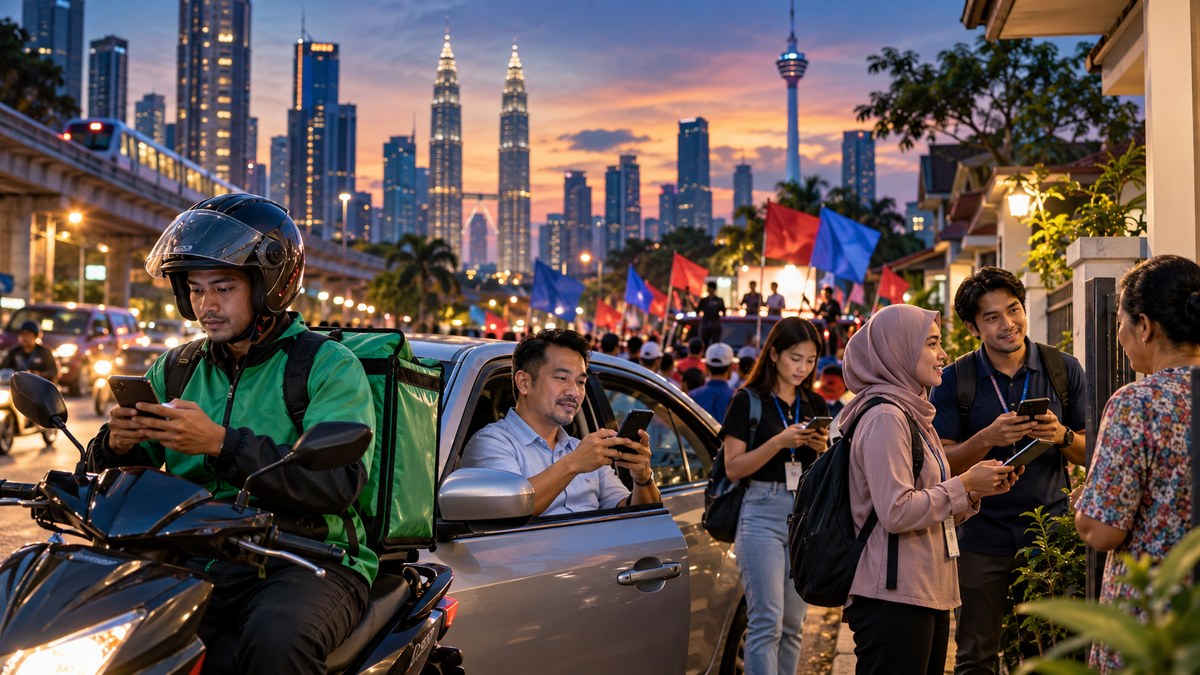
The familiar hum of a motorcycle engine, the flash of a green GrabFood jacket in a traffic jam, the glow of a laptop screen in a late night mamak. This is the backdrop of Malaysia’s 2026 election season. The gig economy is no longer just a side hustle for many Malaysians. It has become a central force in how political campaigns are run, how policies are shaped, and how votes are won. For the estimated 1.5 million gig workers in the country, their daily reality of flexible work, inconsistent income, and digital dependence is now a political battleground.
Malaysia’s gig economy is directly influencing the 2026 elections in three major ways. First, the passing of the Gig Workers Act 2026 has turned gig workers into a powerful voting bloc demanding protections. Second, political parties now use gig platforms for micro-targeted digital ads and on-the-ground canvassing. Third, the economic instability of gig work is pushing young voters toward candidates who promise better social safety nets.
The Gig Workers Act 2026 and the New Voter Bloc
The most obvious sign of this shift is the new Gig Workers Act 2026. This law, passed earlier this year, was a direct response to years of lobbying by driver and delivery groups. It is the first piece of legislation in Malaysia to formally recognize gig workers as a distinct category of labor, giving them access to basic protections like minimum earnings floors and contributions to PERKESO (SOCSO).
This act did not just change the law. It changed the political calculation for every party.
For decades, the political narrative focused on factory workers, civil servants, and farmers. The gig workforce was seen as a temporary phenomenon. Now, with over a million people relying on platforms like Grab, Foodpanda, and ShopeeFood as their main income source, parties cannot ignore them. The Gig Workers Act 2026 is a direct result of this pressure.
How parties are responding
- Coalition pledges: Both the ruling coalition and the opposition have made specific promises to strengthen the act. Some call for a higher minimum fare floor. Others propose a portable benefits system that follows the worker from app to app.
- Dedicated outreach teams: Every major party now has a “gig economy desk” or a dedicated liaison officer. Their job is to listen to complaints about commission rates, deactivation policies, and safety issues.
- Policy proposals: Parties are competing over who can offer the best “gig worker card” with perks like subsidized phone data, insurance top-ups, and vehicle maintenance vouchers.
“The Gig Workers Act 2026 was a watershed moment. It turned a scattered group of individuals into a recognized political constituency. Now, parties are scrambling to show they understand the daily struggles of a p-hailing rider, not just the factory worker,” says political analyst Dr. Faridah Hassan.
This new law has also created a more organized base. Groups like the Malaysian Gig Workers Coalition now have a formal seat at the table when policies are discussed. This is a far cry from the situation just a few years ago, when gig workers were largely invisible in policy debates.
The Platform as a Political Tool
The second way the gig economy is influencing the 2026 campaign is through the platforms themselves. Political strategists have realized that the apps gig workers use every day are powerful channels for reaching voters.
Consider the typical day of a rider. They spend hours staring at their phone screen, waiting for orders, checking maps, and reading notifications. This is prime real estate for political messaging.
How campaigns use gig platforms
- In-app advertising: Some platforms now allow targeted video ads that play before a rider accepts a job. A 15-second clip from a candidate promising lower fuel costs or better road safety can reach thousands of riders in a single afternoon.
- Geo-fenced canvassing: Campaigns use data to identify high-density gig worker areas, like the areas around LRT stations or popular food courts. They then deploy volunteers to hand out flyers or offer free drinks while talking about their candidate.
- Partnership rewards: A few campaigns have experimented with offering small e-wallet top-ups to riders who share a candidate’s campaign video on their social media. This turns the rider into a micro-influencer for the party.
This approach is not without controversy. Critics argue that it blurs the line between work and politics. Riders might feel pressured to support a candidate just to keep their job or to get a small financial reward. The Malaysian Election Commission has issued guidelines to prevent platforms from forcing political content on workers.
| Technique | How it works | Potential mistake |
|---|---|---|
| In-app ads | Short video clips before accepting orders | Overloading riders with ads, causing app fatigue |
| Geo-fenced canvassing | Targeting specific areas with high rider density | Ignoring the diversity of political views in that area |
| Partnership rewards | E-wallet top-ups for sharing content | Being seen as buying votes, which is illegal |
A real world example
During the recent by-election in Johor, one party partnered with a local nasi kandar restaurant to offer a 50 sen discount for riders who showed a campaign sticker on their delivery bag. The campaign quickly went viral on TikTok, with riders debating whether the discount was worth the political endorsement. It was a small gesture, but it showed how deeply the gig economy is woven into campaign tactics.
Economic Anxiety as a Political Driver
The third and perhaps most powerful influence is the economic reality of gig work itself. For many young Malaysians, especially Gen Z and younger millennials, the gig economy is not a choice. It is the only option.
Traditional full-time jobs with fixed salaries, EPF contributions, and annual bonuses are becoming harder to find. The cost of living in cities like Kuala Lumpur, Penang, and Johor Bahru continues to rise. This economic anxiety is a major factor driving voter behavior in 2026.
A recent survey by the Merdeka Center found that 68% of gig workers under 30 say their financial situation has worsened over the past three years. This group is highly motivated to vote for change. They are looking for candidates who promise:
- Stable income policies: Minimum fare guarantees, anti-surge pricing regulations, and limits on platform commission fees.
- Social safety nets: Better access to healthcare, housing loans, and education subsidies. The Gig Workers Act 2026 is a start, but many workers want more.
- Digital infrastructure: Faster internet in rural areas, better public transport for commuters, and safer roads for delivery riders.
This economic anxiety is not just a talking point. It is a voting issue. In the last general election, the youth vote was split. In 2026, the gig economy has given that vote a sharper focus. Candidates who talk about “the rakyat” in general terms are losing ground to those who specifically address the struggles of a Grab driver or a freelance graphic designer.
A table of voter priorities
| Priority | What gig workers want | How it influences campaign strategy |
|---|---|---|
| Income stability | Minimum earnings floor, fair commission caps | Parties promise to regulate platform pay |
| Social protection | PERKESO contributions, EPF for gig workers | Campaigns highlight their support for the Gig Workers Act 2026 |
| Cost of living | Cheaper fuel, affordable housing, public transport | Candidates propose subsidies and infrastructure projects |
| Digital rights | Data privacy, fair deactivation policies | Parties pledge to create a digital consumer protection agency |
This focus on economic issues has also changed the tone of campaigns. Instead of grand speeches about national unity or foreign policy, candidates are spending more time in kopitiams and mamak stalls, listening to riders complain about the price of petrol or the difficulty of getting a home loan. It is a more grounded, more local form of politics.
What This Means for the Future of Malaysian Politics
The gig economy is not going away. By 2027, it is projected to account for nearly 15% of Malaysia’s workforce. That means the influence of gig workers on politics will only grow.
We are already seeing a shift in how parties build their manifestos. In 2026, every major party’s election platform includes a dedicated section on the gig economy. This is a direct result of the political pressure exerted by this new voting bloc.
For the average Malaysian, this is a good thing. It means politicians are being forced to talk about real issues: income, security, and opportunity. The days of vague promises are fading. In their place are specific proposals about platform regulation, social safety nets, and digital rights.
But there are challenges too. The gig workforce is diverse. A food delivery rider in Subang Jaya has different needs than a freelance graphic designer in George Town. Parties will need to craft policies that address this diversity without being too generic.
Also, there is the risk of “gig-washing.” Some candidates might pay lip service to gig workers without enacting real change. Voters will need to stay informed and hold their representatives accountable.
To understand how these trends fit into the bigger picture, you can read more about how Malaysia’s political landscape will evolve in 2026. You can also check out our analysis of the role of youth in shaping Malaysia’s political future.
Your Role in This New Political Reality
Whether you are a gig worker yourself, a student, or just a concerned citizen, this shift affects you. The next time you see a campaign poster next to a food delivery hub, or hear a politician talk about “digital workers,” remember that this is not just rhetoric. It is the sound of a new political force finding its voice.
The best thing you can do is to stay engaged. Ask your local candidate specific questions about the Gig Workers Act 2026. Find out what they plan to do about platform commissions. Share this knowledge with your friends who are riders or drivers.
Politics in Malaysia is no longer just about the old coalitions. It is about the people who keep the city moving, one delivery at a time. And in 2026, their voice is louder than ever.




Leave a Reply