
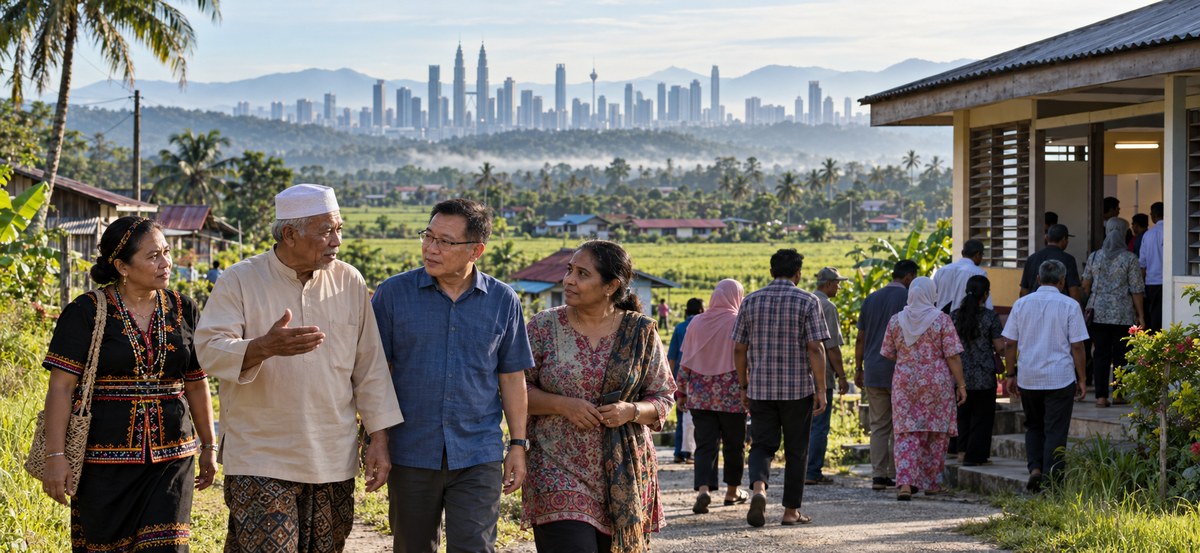
In the lead-up to the 2026 general election, political analysts are scratching their heads. National polls suggest a swing toward urban-centric reformist parties, yet the ground in rural Malaysia tells a different story. From the paddy fields of Kedah to the longhouses of Sarawak, rural voters are making choices that seem to contradict the headlines. This divergence is not random. It is a calculated response to local realities, economic pressures, and a deep-seated distrust of promises made in Kuala Lumpur. Understanding this gap is the key to predicting the future of Malaysian politics.
Malaysia’s rural voters in 2026 are not simply following national party lines. They are prioritising local bread-and-butter issues like cost of living, access to healthcare, and infrastructure over ideological battles. This grassroots defiance is reshaping campaign strategies, forcing national coalitions to tailor messages for the kampung, not just the condo.
The Three Pillars of Rural Voting Behaviour
Rural voters in Malaysia operate on a different set of priorities. While urban voters might debate national policies on social media, rural communities focus on tangible outcomes. Three main factors drive this behaviour.
-
Local Economic Survival. The cost of a weekly shop in a rural market in Kelantan feels very different from a trip to a supermarket in Bangsar. Subsidies for fuel, rice, and fertiliser are not abstract policies. They are survival tools. A party that promises to protect these subsidies often wins loyalty, regardless of its national stance on corruption or reform.
-
Trust in Local Figures. A candidate who shows up at a wedding in a village, helps after a flood, or gets a road fixed earns trust that no national advertisement can buy. Rural voters often vote for the person, not the party logo. This personal connection overrides national party branding.
-
Access to Information. Internet penetration in rural areas is improving, but many still rely on community networks, local newspapers, and word of mouth. National scandals may not reach a voter in a remote part of Sabah as quickly as news of a new clinic opening. This creates a lag in political sentiment.
Why National Trends Are Falling Flat
National political trends in 2026 are heavily influenced by the Klang Valley and other urban centres. Issues like institutional reform, anti-corruption campaigns, and foreign policy dominate the news cycle. But in rural Malaysia, these issues feel distant.
For example, the push for a two-party system may excite political scientists, but a farmer in Perlis cares more about the price of rubber. The debate over federal-state relations is important in Kuching, but a villager in Terengganu might simply want a reliable water supply. This disconnect means that national coalitions cannot assume a one-size-fits-all message.
“The mistake national parties make is treating rural voters as a monolith. A voter in a Felda scheme in Pahang has completely different concerns from a fisherman in Kuala Terengganu. You cannot campaign in both places with the same speech.” — Dr. Aminah Yusof, political analyst at Universiti Malaya.
A Practical Guide to Understanding Rural Shifts
For political analysts and journalists, here is a numbered list of steps to accurately gauge rural sentiment in 2026.
- Map the Local Economy. Identify the main economic driver of the area. Is it palm oil, rubber, fishing, or tourism? A party’s policy on subsidies or exports will directly affect voting.
- Identify Key Influencers. Who do people trust? It might be the village head, a local religious leader, or a successful businessman. Their endorsement often matters more than a party manifesto.
- Track Local Media. Read the local newspapers and listen to community radio. National media often misses the grassroots stories that shape local opinion.
- Attend Non-Political Events. Go to a pasar malam or a community feast. Political conversations happen naturally in these settings, away from the pressure of a formal rally.
- Compare By-Election Results. By-elections in rural seats are excellent indicators. They show how voters react to specific local issues without the noise of a general election.
Common Mistakes in Analysing Rural Voters
Analysts often make errors when interpreting rural voting patterns. The table below outlines common mistakes and the correct approaches.
| Common Mistake | Correct Approach |
|---|---|
| Assuming all rural voters are conservative. | Recognise that rural voters can be progressive on local issues like land rights or healthcare access. |
| Using national polling data without local filters. | Segment data by state, district, and even mukim to see real trends. |
| Ignoring the role of local patronage. | Accept that personal favours and community help are part of the political system. |
| Focusing only on Malay-majority areas. | Remember that rural areas in Sabah and Sarawak have diverse ethnic and religious compositions. |
| Believing internet access equals influence. | Understand that social media is filtered through local trust networks. |
The Role of Youth and Digital Campaigns
Younger rural voters in 2026 are a fascinating group. They have smartphones and access to TikTok and WhatsApp, but their priorities are still shaped by their local environment. A young rubber tapper in Johor might watch national political debates online, but his vote is influenced by the condition of the local road and the price of his crop.
Political parties are learning this the hard way. A digital campaign that works in Penang may fall flat in a rural district in Sarawak. The most effective campaigns in 2026 are hybrid. They use digital tools to organise and spread information, but they still rely on physical presence and local events to seal the deal. For more on this, read how Malaysia’s political parties are using digital campaigns in 2026.
Key Issues Reshaping Rural Politics
Several issues are driving the current defiance of national trends.
- Cost of Living. This is the number one issue. Rural families feel the pinch of inflation more acutely. A small increase in the price of cooking oil or rice can shift an entire community’s vote.
- Healthcare Access. Rural clinics are often understaffed and understocked. A party that promises a new hospital or mobile clinic gets immediate attention.
- Infrastructure. Roads, water, and electricity remain inconsistent in many rural areas. These are not abstract “development” issues. They are daily frustrations.
- Education and Jobs. Parents want their children to have opportunities without moving to the city. Policies on vocational training and local industry are crucial.
- Federal-State Relations. This is especially important in Sabah and Sarawak. Voters there are increasingly voting for parties that promise more autonomy and a fairer share of revenue. The growing political voice of these states is a major factor in 2026. Learn more about how Sabah and Sarawak’s growing political voice is shifting federal power in 2026.
The Economic Factor: A Deeper Look
The economy is the engine of rural voting. When the national economy does well, rural areas may not feel the benefits immediately. When it struggles, they feel the pain first. Subsidies are a lifeline. Any party seen as threatening fuel or food subsidies risks losing entire constituencies.
In 2026, the debate over the national budget has become a central battleground. Rural voters are watching closely. They want to see budget allocations for their specific areas. A road project or a new school can swing a seat. For a detailed breakdown of how the budget influences politics, see how Malaysia’s budget 2026 reshapes political alliances.
What This Means for Political Coalitions
National coalitions are being forced to adapt. They cannot rely on a single national message. Instead, they are creating regional manifestos and fielding local candidates with strong community roots. The era of flying in a national leader for a rally and expecting votes is over.
Coalitions are also investing in local infrastructure projects as campaign tools. This is not new, but the scale is different. In 2026, voters are more cynical. They want to see results before the election, not just promises during the campaign. This has led to a rise in “service politics,” where local representatives are judged on their ability to fix drains, issue land titles, and secure funding for community halls.
The Path Forward for Analysts
To truly understand why Malaysia’s rural voters are defying national political trends in 2026, one must spend time on the ground. Data from the city will only tell half the story. The real insights come from listening to the conversations at a kedai kopi in a small town.
This defiance is not a rejection of national politics. It is a demand for relevance. Rural voters are saying that their lives, their struggles, and their aspirations matter. They will vote for the party that listens, not the one that lectures.
How to Use This Analysis
The next time you read a national poll, pause. Ask yourself how that data changes when you filter by district. Look for the local stories that explain the numbers. The gap between national trends and rural reality is not a problem to be solved. It is a reality to be understood. For those who take the time to learn it, the payoff is a much clearer picture of Malaysia’s political future. For more context on the broader shifts, you can also read about Malaysia’s political stability in 2026.







Leave a Reply