
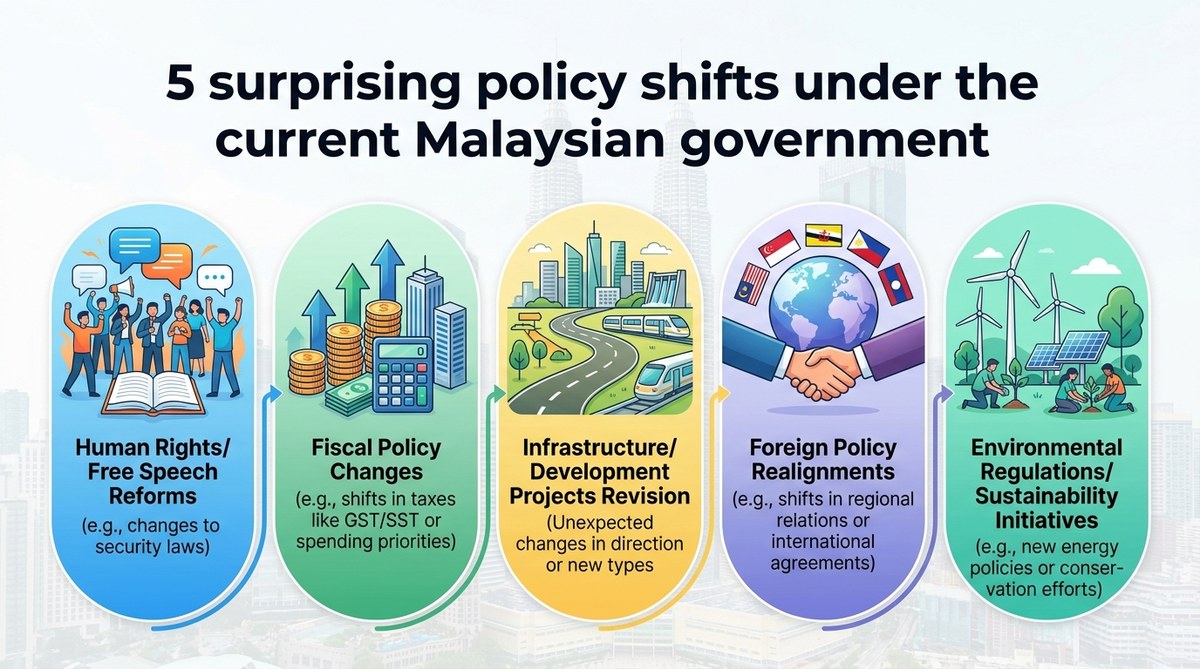
When Malaysia’s current unity government first took office, many expected a steady, cautious approach to governance. Instead, the leadership has rolled out a series of bold policy shifts that caught even seasoned political watchers off guard. Some of these moves break decades-old taboos. Others quietly redefine how the government interacts with businesses, workers, and households. For political enthusiasts and expats tracking Malaysia’s direction, understanding these changes is more than an academic exercise. It shapes how you plan your investments, career moves, and daily life in this country.
The Malaysian unity government has introduced several bold policy shifts since taking office, surprising both supporters and critics. From removing blanket fuel subsidies to mandating EPG contributions for foreign workers, these changes signal a new direction for the nation. This article breaks down five unexpected reforms, explaining their rationale, implementation, and impact on businesses and everyday Malaysians in 2026. Understanding these shifts matters for anyone tracking Malaysia’s political and broader economic trajectory within Southeast Asia.
The Political Shockwave Nobody Saw Coming
Malaysia’s political scene has always had its share of surprises. But the policy moves under the current administration feel different. They are not just routine adjustments. They signal a fundamental rethinking of how the government sees its role in the economy and society. Some of these policies were hinted at during the election campaign. Others appeared with little warning, leaving businesses and citizens scrambling to adapt.
To understand why these shifts matter, you need to see them against the backdrop of Malaysia’s recent political history. The unity government was formed after a prolonged period of instability, with three prime ministers in four years. Many assumed the coalition would play it safe. Instead, it took on politically sensitive reforms that previous administrations avoided for decades. This willingness to act has reshaped the conversation around Malaysia’s future, both at home and abroad. For a broader look at how these changes fit into the country’s political trajectory, you can read more about understanding Malaysia’s political landscape post-elections.
1. The Great Fuel Subsidy Shakeup
For years, fuel subsidies were considered politically untouchable. Every government knew the system was inefficient. The richest Malaysians benefited just as much as the poorest from the blanket subsidy on RON95 petrol. But nobody wanted to be the one to remove it. The current government broke that taboo.
Starting in 2024, the government began a phased rationalisation of the RON95 subsidy. Instead of a flat subsidy for everyone, it introduced a targeted system. Only households in the bottom 80% of income earners (the B40 and most of the M40 groups) would receive the subsidy. The top 20% would pay market rates. The rollout was tied to the PADU database, a national socioeconomic registry that consolidates household income data.
This shift was not without controversy. Critics argued that the PADU database had errors, leaving some deserving households without access to the subsidy. Others pointed out that the savings from subsidy removal would be redirected to public services, including healthcare and education. By 2026, the policy has largely settled in place. Fuel prices now float closer to market levels for higher-income groups, while lower-income families still get support.
The impact on daily life has been noticeable. Families in the T20 bracket now pay around RM3.35 per litre for RON95, up from the subsidised rate of RM2.05. For a household with two cars, this adds hundreds of ringgit to monthly expenses. Meanwhile, lower-income groups have seen their fuel costs remain stable. The money saved from the reform has been partially channelled into targeted cash transfers and public transport improvements.
2. Your Boss Gets a New Rulebook: Progressive Wages
Malaysia’s wages have long been a sore point. Despite steady economic growth, median salaries have not kept pace with rising living costs. The current government introduced the Progressive Wage Policy (PWP) to address this gap. The idea is simple: instead of a flat minimum wage that applies to everyone, wages should increase as workers gain skills and experience.
The PWP is voluntary for employers, at least for now. Companies that adopt the framework and raise their workers’ wages according to a structured progression ladder receive tax incentives and government grants. The policy targets workers in the formal sector, especially in manufacturing, retail, and services. It encourages employers to invest in training and upskilling, with the government sharing part of the cost.
Critics say the voluntary nature of the policy limits its impact. But early data from 2025 showed that over 12,000 companies had signed up, covering more than 200,000 workers. For employees, the policy offers a clear path to higher pay without having to switch jobs. For businesses, it creates a more stable workforce with lower turnover.
What does this mean for expats? If you are employed in Malaysia under a work permit, the policy does not directly apply to you. But it does affect the broader labour market. As local wages rise, the gap between expat and local salaries may narrow over time. Companies may also become more cautious about hiring foreign workers if local talent becomes more expensive but also more skilled.
3. EPG for Foreign Workers: A Quiet Revolution
This policy shift caught many by surprise. In early 2024, the government announced that all foreign workers would be required to have EPG (Employees Provident Fund) contributions from their employers. This was a major departure from the past, when foreign workers were largely excluded from Malaysia’s retirement savings system.
Previously, foreign workers received no mandatory retirement savings from their employers. They could opt into voluntary schemes, but most did not. The new rule requires employers to contribute 12% of a foreign worker’s monthly salary to an EPG account. The worker can withdraw the full amount when they leave Malaysia permanently.
The rationale behind this policy is twofold. First, it ensures that foreign workers leave Malaysia with some savings, which supports the country’s reputation as a fair employer. Second, it levels the playing field between local and foreign labour costs. Before this change, hiring foreign workers was cheaper partly because employers did not have to make EPG contributions. This created a disincentive to hire locals.
For businesses that rely heavily on foreign labour, the impact has been significant. A factory with 500 foreign workers now faces additional monthly costs of around RM30,000 to RM50,000, depending on salary levels. Some employers have responded by automating processes or reducing their reliance on foreign labour. Others have passed the cost on to consumers.
For expats living in Malaysia, the policy also affects you if you are employed locally and earning an income in Malaysia. You are classified as a foreign worker under EPG rules, so your employer must now contribute to your EPG account. This is a net positive for you, as it builds a retirement nest egg that you can cash out when you leave.
4. Going Nuclear: Malaysia’s Energy Transition Gets Real
Malaysia has talked about renewable energy for years. But the current government surprised everyone by adding nuclear energy to the conversation. In 2024, the government released the National Energy Transition Roadmap (NETR), which included nuclear power as part of the long-term energy mix.
This was a shock because Malaysia has no operational nuclear power plants and only limited experience with nuclear technology. Public opinion has historically been cautious about nuclear energy, especially after the Fukushima disaster in 2011. But the government argues that nuclear is necessary to meet Malaysia’s net-zero emissions target by 2050.
The NETR sets a target of 40% renewable energy capacity by 2035, up from around 25% in 2023. Solar and hydropower will lead the way. But the roadmap also allocates funding for a feasibility study on small modular reactors (SMRs), a newer type of nuclear technology that is smaller and safer than traditional reactors.
The business community has responded positively to the clarity provided by the NETR. Energy companies now have a clear signal about where the government is headed. Investments in solar farms, battery storage, and grid modernisation have increased. For expats and Malaysian homeowners, the shift means more options for rooftop solar and potentially lower electricity costs in the long run.
This policy shift also positions Malaysia as a serious player in the regional energy transition. Neighbouring countries like Indonesia and Vietnam are also exploring nuclear energy, and Malaysia’s early feasibility work could give it a first-mover advantage in Southeast Asia. For more on how these changes connect to broader regional dynamics, see our analysis of Malaysia’s political stability in 2026.
5. Malaysia Goes All-In on Digital
The digital economy is not a new priority for Malaysia. But the current government has accelerated the pace significantly. In 2024 and 2025, a series of policy moves created a much more favourable environment for digital businesses and consumers.
First, the government awarded five digital banking licences in 2024, allowing new players to compete with traditional banks. These digital banks are still in their early stages, but they have already started offering services to underserved groups, including gig workers and small businesses that struggle to get credit from traditional banks.
Second, the e-wallet sector received a major boost. The government launched a national e-wallet initiative that gave every adult Malaysian RM100 in digital credits to spend at participating merchants. This programme drove a massive increase in e-wallet adoption, especially among older Malaysians who had been slow to adopt digital payments.
Third, the government introduced a regulatory sandbox for artificial intelligence and fintech startups. This allows new companies to test their products without being subject to full regulatory requirements for a limited period. The goal is to encourage innovation while managing risks.
For businesses, these changes create new opportunities. If you run a small business, you can now accept digital payments more easily and access financing through digital lenders. For expats, the digital banking licences mean more options for managing your finances in Malaysia, with lower fees and better exchange rates compared to traditional banks.
The table below summarises how each of these five policy shifts affects different groups in Malaysia:
| Policy Shift | B40 Households | M40 Households | T20 / Expats | Businesses |
|---|---|---|---|---|
| Fuel subsidy reform | Prices stable, cash transfers | Slightly higher costs | Much higher fuel costs | Higher logistics costs |
| Progressive wage policy | Indirect benefit | Direct wage increases | No direct impact | Higher labour costs, tax incentives |
| EPG for foreign workers | No direct impact | No direct impact | EPG contributions start | Significant cost increase |
| Nuclear energy exploration | Lower future electricity costs | Lower future costs | Clean energy access | New investment opportunities |
| Digital economy push | E-wallet credits, digital access | More banking options | Digital banking, fintech | New tools and funding |
Blockquote for expert voice:
“The current government has shown a willingness to tackle issues that were considered too sensitive for decades. The fuel subsidy reform alone is a political landmark. But the real test will be whether these policies survive the next election cycle. Policy continuity is the missing piece in Malaysia’s governance puzzle.” – Dr. Sarah Lim, Senior Fellow at the Malaysian Institute of Economic Research
What to Watch for Next
If you want to stay ahead of these changes, here is a practical set of steps you can take:
-
Check your EPG status. If you are a foreign worker or an expat employed in Malaysia, log into your EPG account to confirm that your employer is making the required contributions. This is your money, and you want to make sure it is being set aside properly.
-
Review your household fuel budget. If you are in the T20 bracket, your fuel costs have gone up. Consider switching to a more fuel-efficient vehicle or using public transport more often. The savings can be substantial over a year.
-
Understand the Progressive Wage Policy if you employ staff. If you run a business in Malaysia, look into the tax incentives available for adopting the PWP framework. It may be cheaper than you think, and it can help you retain good workers.
-
Track the NETR developments. If you own a home or business property







Leave a Reply