
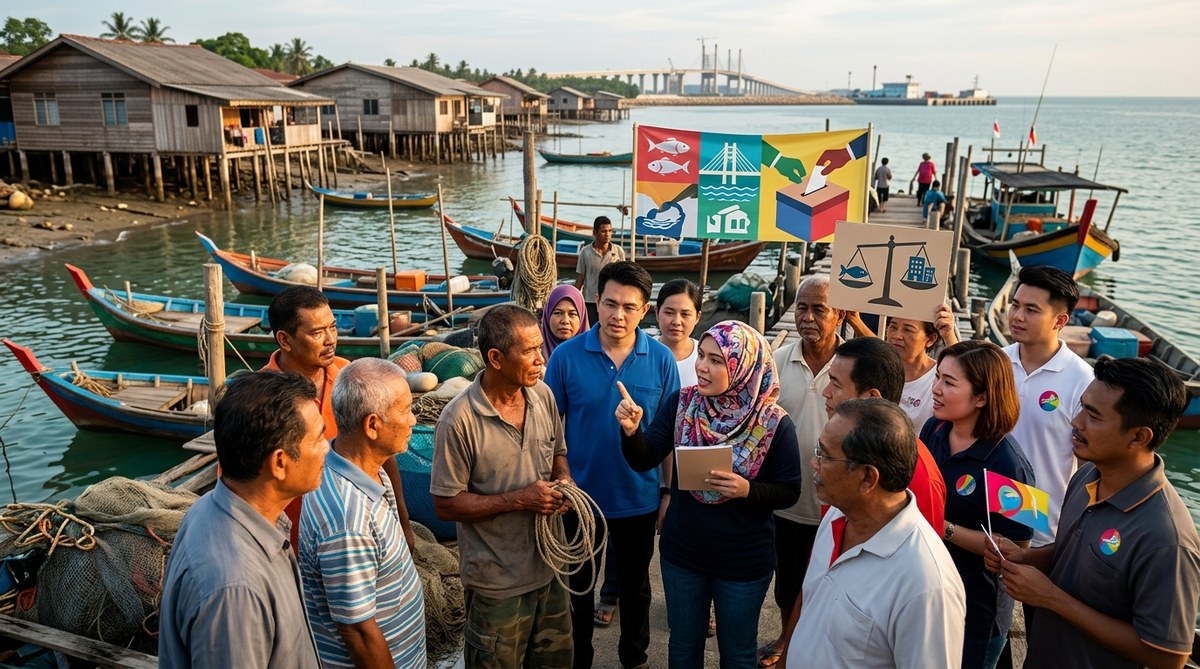
The fishing boats are coming back to port with smaller hauls. The waves are lapping higher against the wooden stilt houses in Kampung Nelayan. And the old political certainties that once anchored Malaysia’s coastal villages are washing away. For decades, communities from Kuala Terengganu to Kota Kinabalu were seen as fixed votes. Fishermen, seaweed farmers, and tourism workers voted along predictable lines. Not anymore. In 2026, these coastal communities are emerging as the most unpredictable bloc in the country. They are the new swing voters, and both sides of the political divide are scrambling to understand them.
Malaysia’s coastal communities are transforming from loyal voting blocs into genuine swing voters in 2026. Rising sea levels, volatile fish stocks, and broken promises on subsidies have eroded party loyalty. Politicians who ignore the three core issues of economic survival, climate adaptation, and infrastructure neglect will lose these decisive seats. Understanding this shift is essential for anyone forecasting the next general election.
Why loyalty is fading along the shoreline
Walk through any coastal village in Malaysia today and you will hear the same complaints. The diesel subsidy reforms hit hardest here. Fishermen pay more to go out to sea while watching their catch shrink. The monsoon seasons are getting less predictable. Floods arrive earlier and stay longer. And the promises made during campaign season? They often disappear once the ballots are counted.
This pattern has created a deep well of distrust. In the 2022 general election, several coastal seats in Terengganu and Kelantan swung dramatically. Voters who had backed Barisan Nasional for decades switched to Perikatan Nasional. But here is the twist: many of those same voters now say they feel let down again. They are keeping their options open for 2026.
The shift is not just about broken promises. It is about survival. When your livelihood depends on the health of the ocean, and the ocean is changing, you start paying attention to who offers real solutions. Not slogans. Not flags. Actual solutions.
The three issues that decide coastal votes
Political analysts tracking the Malaysia coastal communities swing voters 2026 trend point to three dominant issues. These are not abstract national debates. They are kitchen table concerns that decide how a family eats, whether a child goes to university, and if a house will survive the next storm.
1. Economic survival at sea
The cost of fishing has gone up. Fuel, ice, nets, and boat maintenance all cost more. Meanwhile, the price of ikan kembung at the market has not kept pace. Many fishermen now operate at a loss. They rely on government subsidies to stay afloat. But those subsidies come with strings attached. And they change every time a new government takes office.
Small-scale fishermen in places like Pulau Ketam and Kuala Selangor say they need consistent policy, not election year handouts. They want a stable diesel price, access to cold storage facilities, and help marketing their catch directly to consumers. Parties that offer a clear plan for the fishing industry will win these voters.
2. Climate change is not a debate here
Coastal communities do not argue about whether climate change is real. They watch the sea claim their land. In 2025, the northeast monsoon caused some of the worst coastal erosion in decades. Homes in Bachok, Sabak Bernam, and Sandakan were damaged or destroyed. The government’s response was slow. Many families are still waiting for compensation.
In 2026, voters remember. They remember which party sent help during the floods. They remember which assemblyman showed up with sandbags. And they remember which politicians only appeared when cameras were rolling. Climate adaptation is now a voting issue in every coastal constituency.
3. Infrastructure that connects them to opportunity
Coastal villages are often the last to receive upgrades. Roads are narrow, internet is patchy, and healthcare facilities are far away. Young people leave for the cities because they cannot build a future in their hometowns. Parents watch their children move to Johor Bahru or the Klang Valley, and they blame the government for not creating opportunities locally.
Parties that promise better digital connectivity, improved roads, and local job creation will find a receptive audience. But the promises must be credible. Coastal voters have heard too many grand plans that never materialised.
How parties are trying to win them back
Both the government and the opposition are investing heavily in coastal outreach. But their approaches differ significantly. Here is how they compare:
| Strategy | Government coalition | Opposition coalition |
|---|---|---|
| Messaging | Delivered promises on subsidies and flood mitigation | Blames previous governments for neglect |
| Key platform | Continuity and gradual improvement | Change and disruption |
| Weakness | Slow delivery and bureaucratic delays | Lack of track record in power |
| Outreach method | Direct cash aid and development projects | Social media and youth engagement |
| Risk | Voters see them as out of touch | Voters see them as untested |
The table above shows why coastal voters are genuinely torn. The government offers stability but has been slow to act. The opposition offers energy but has not proven it can govern. For a fisherman deciding how to vote, neither option feels perfect.
A practical guide for understanding coastal voters
If you are a political analyst, a campaign strategist, or just a curious reader, here is a simple way to track this voting bloc:
-
Map the constituencies. Focus on seats with a high percentage of fishermen, seaweed farmers, and tourism workers. Key areas include Kuala Terengganu, Besut, Bachok, Sandakan, and Semporna. These are the seats that could flip in 2026.
-
Follow the subsidy announcements. Watch for changes to diesel subsidies, fishing license fees, and the price control mechanism for essential fish. Every adjustment affects thousands of families directly.
-
Monitor flood response times. When the monsoon hits, note which constituencies receive aid first. Speed of response is a powerful signal to voters.
-
Listen to local media. Read the community newspapers and radio stations in coastal areas. They carry stories that national media often miss. These stories shape local opinion.
-
Attend town hall sessions. If you can, sit in on the ceramah sessions in coastal villages. The questions asked by residents reveal their priorities better than any poll.
“The coastal voter in 2026 is the most pragmatic voter in Malaysia. They will vote for whoever can prove they will fix the jetty, stabilise the diesel price, and keep their children from moving to Kuala Lumpur.” – Dr. Faridah Mohd Noor, political analyst at Universiti Sains Malaysia
What this means for the 2026 election
The rise of coastal swing voters changes the math for both major coalitions. In the past, parties could ignore these communities and still win. They relied on urban centres and plantation seats to carry them through. That is no longer possible. The coastal seats are too numerous, and too competitive, to be taken for granted.
Consider the numbers. There are over 40 parliamentary seats with significant coastal populations. In a tight election, winning even half of these seats could determine who forms the government. That is why both sides are paying attention to fishing license reforms, marine park policies, and coastal development plans.
But there is a deeper lesson here. The Malaysia coastal communities swing voters 2026 phenomenon is not a temporary blip. It reflects a broader shift in Malaysian politics. Voters are becoming more issue-driven and less loyal to parties. They are willing to switch sides if they see better options. Coastal communities are just the most visible example of this trend.
For a closer look at how these changes fit into the bigger picture, read our analysis on understanding Malaysia’s political landscape post-elections. You can also explore how the role of youth in shaping Malaysia’s political future connects with the coastal vote.
Reading the tide for 2026
The sun sets over the Strait of Malacca, painting the sky orange and pink. A fisherman ties his boat to the jetty. He has heard the promises from every party. He has seen the floods, the rising costs, and the children who left. In 2026, he will walk into the polling station and make a choice. That choice will not be based on family tradition or party colour. It will be based on one question: who can actually improve my life?
For political parties, the answer to that question must be honest and actionable. For voters, the power is finally in their hands. The coastal communities of Malaysia are no longer reliable votes for anyone. They are the new deciders. And in 2026, they will make their voices heard.









Leave a Reply