
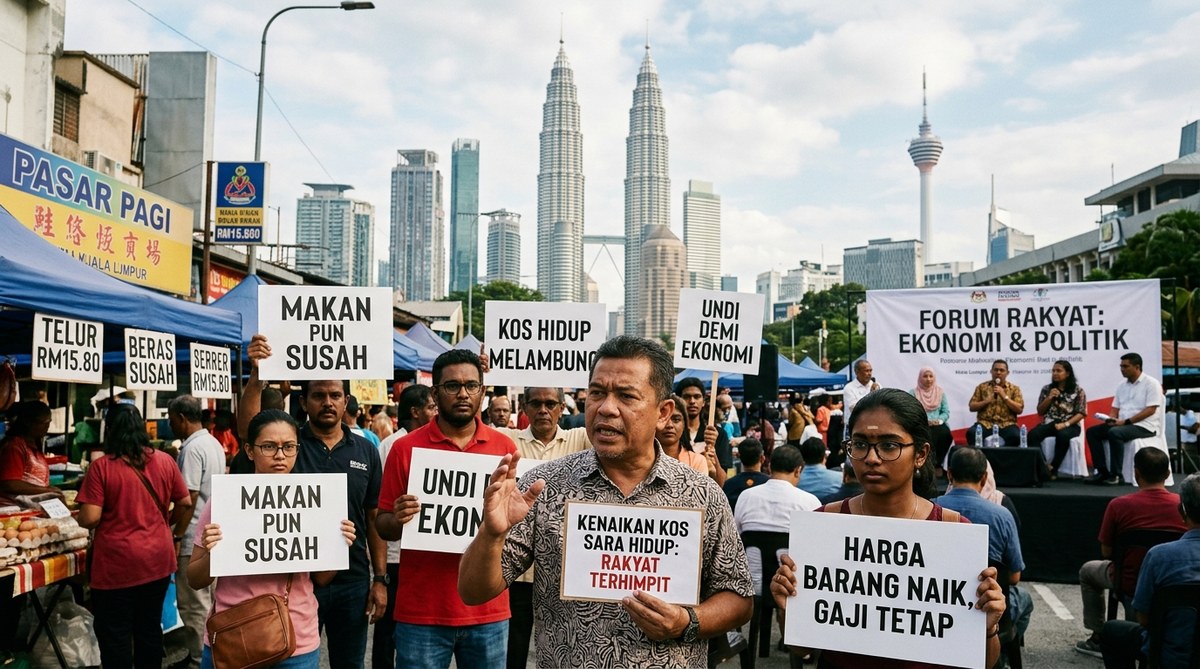
The price of a plate of nasi lemak in your neighbourhood kopitiam tells a story that no politician can ignore. When the cost of a simple breakfast rises by 50 sen, it does not just affect your morning budget. It changes how you vote. Across Malaysia, from the wet markets of Penang to the housing estates of Johor Bahru, the cost of living crisis has become the single most powerful force reshaping the country’s political landscape. It has toppled assumptions, broken old loyalties, and forced every party to rewrite its playbook.
Malaysia’s cost of living crisis is not just an economic problem. It is the defining political issue of 2026. Voter anger over high prices is fracturing traditional coalition support, forcing the government into costly subsidy programmes, and giving opposition parties a powerful rallying cry. Understanding how this crisis drives political behaviour is essential for anyone tracking Malaysia’s future.
The price of politics: How inflation became the ballot box issue
Malaysia’s headline economic numbers still look respectable. GDP growth hovers around 4 to 5 percent. The stock market is active. Yet the lived reality for most households tells a different story. Wages have not kept pace with inflation. The ringgit’s purchasing power has eroded. Essentials like cooking oil, chicken, and petrol eat up a larger share of monthly income than they did five years ago.
This gap between macro statistics and kitchen table economics has created a dangerous mood. Voters feel that the system is working for everyone except them. And they are taking that anger to the polls.
Political parties have noticed. In the 2022 general election, the cost of living was already a top concern. By 2026, it has become the only issue that matters for a large slice of the electorate. A recent survey by a local research institute found that nearly 70 percent of respondents ranked inflation and household expenses as their primary voting priority, ahead of corruption, education, or national security.
How the crisis is breaking old coalition loyalties
The most visible political impact of the cost of living crisis is the erosion of traditional voting blocs. For decades, Malaysian politics was shaped by identity based loyalties. Race, religion, and geography often determined how someone voted. Those patterns are now cracking.
Consider the Malay heartland. The ruling coalition has historically relied on strong support from rural and semi urban Malay voters. But as the cost of living squeezes these communities, many are questioning their allegiance. A fisherman in Terengganu or a rubber tapper in Kedah does not care about fiscal responsibility if he cannot afford to fill his motorbike’s tank. The opposition has capitalised on this frustration, promising direct cash handouts and price controls that sound appealing to struggling families.
Urban middle class voters are shifting too. Young professionals in the Klang Valley, once seen as a reliable base for reformist parties, are becoming harder to please. They want competent economic management, not just slogans. If prices keep rising, they are willing to punish incumbents regardless of which coalition they belong to.
This volatility is making coalition building much harder. As we discussed in our analysis of how Malaysia’s political landscape will evolve in 2026, the old certainties are gone. Every by election now feels like a referendum on the government’s handling of the economy.
The government’s balancing act: Subsidies versus reform
The government faces a brutal trade off. It needs to reduce the fiscal deficit, which means cutting costly blanket subsidies. But every attempt to remove or reduce subsidies triggers a political firestorm.
The diesel subsidy rationalisation programme is a perfect example. When the government tried to target subsidies more effectively, opposition parties painted it as an attack on the rakyat. The resulting backlash forced the government to slow down its reforms. This pattern repeats across multiple sectors. The result is a policy paralysis where meaningful structural change is postponed to avoid electoral pain.
Here is a practical look at how the current government is trying to manage this balancing act:
- Retaining blanket subsidies for essential items like rice and cooking oil, but capping the volume available at subsidised prices.
- Expanding targeted cash assistance through programmes like Sumbangan Tunai Rahmah, but struggling to ensure the data is accurate and up to date.
- Increasing the minimum wage gradually, hoping that higher incomes will offset higher prices.
- Delaying the full implementation of the fuel subsidy rationalisation until after the next general election.
- Introducing price control mechanisms during festive seasons, which provide temporary relief but do not solve the underlying problem.
Each of these steps is a political compromise. None of them fully satisfies voters or economists. The government is essentially buying time, hoping that global commodity prices ease or that wage growth catches up.
What voters are demanding from their leaders
The cost of living crisis has changed what Malaysians expect from their politicians. It is no longer enough to wave the party flag or invoke historical loyalties. Voters want practical answers to three specific questions:
- How will you make my monthly expenses lower?
- How will you ensure my salary keeps up with prices?
- How will you protect me from unexpected price shocks?
Parties that fail to answer these questions convincingly are punished at the ballot box. This has forced a shift in campaign strategy. As we saw in our piece on how Malaysia’s political parties are using digital campaigns in 2026, parties are now using social media to share concrete proposals on cost of living issues, rather than just attacking opponents.
The opposition’s opportunity and its risks
For opposition parties, the cost of living crisis is a gift. It gives them a simple, powerful message: the government has failed to protect the rakyat. They can point to rising prices and ask voters whether they are better off than they were five years ago.
But the opposition also faces risks. If they promise too much, voters will expect them to deliver if they ever take power. And the tools available to any government to control prices are limited. Global inflation, supply chain disruptions, and currency fluctuations are not easily managed by domestic policy alone.
“The party that wins the next election will not be the one with the best ideology. It will be the one that convinces voters it can put more money in their pockets at the end of each month.” – Dr. Faridah Ismail, political economist at Universiti Malaya
The opposition’s challenge is to offer credible solutions, not just criticism. Voters are sophisticated enough to recognise empty promises. A party that promises to halve the price of chicken overnight will be seen as either dishonest or naive.
A table comparing party approaches to the crisis
Different coalitions are taking different approaches to the cost of living issue. Here is a summary of their main strategies:
| Party or coalition | Core approach | Key proposal | Political risk |
|---|---|---|---|
| Pakatan Harapan led government | Targeted subsidies and cash aid | Sumbangan Tunai Rahmah, price controls | Seen as insufficient by voters |
| Perikatan Nasional | Roll back subsidy reforms | Reintroduce blanket subsidies | Could worsen fiscal deficit |
| Barisan Nasional (as opposition) | Focus on economic growth | Incentives for businesses to raise wages | Slow to deliver results |
| Smaller parties (Muda, Pejuang) | Radical reform | Price caps on essentials, basic income | Seen as unrealistic |
Each approach has trade offs. The government’s strategy is fiscally responsible but politically unsatisfying. The opposition’s promises are popular but may be impossible to keep.
How the crisis is reshaping policy making
Beyond elections, the cost of living crisis is changing how policies are designed and communicated. Ministries now run every new regulation through a “cost of living impact assessment”. Any policy that could raise prices, even slightly, faces intense scrutiny.
This has slowed down some important reforms. Environmental regulations, for example, are being delayed because they could increase production costs for manufacturers. Healthier food standards are being watered down because they might make staple foods more expensive.
The government is also investing heavily in price monitoring systems. Real time data on the prices of essential goods is now collected and published weekly. This transparency is good, but it also means that any price spike becomes immediate political ammunition.
For a deeper look at how these dynamics are playing out in the cabinet, read our analysis on how Malaysia’s cabinet reshuffle in 2026 reflects shifting alliances.
The role of youth voters and social media
Younger voters are particularly sensitive to the cost of living crisis. They entered the workforce during a period of high inflation and stagnant wages. Many are struggling to save for a house, a car, or even a wedding. This generation does not have the same loyalty to traditional parties as their parents.
Social media amplifies their frustration. Every price increase goes viral. Videos of expensive groceries are shared widely. Politicians who seem out of touch with everyday expenses are mocked online. This creates a feedback loop where the crisis feels even more intense than it might be in reality.
Political parties are responding by appointing younger candidates and adopting more relatable communication styles. But the underlying economic pressures remain. As we explored in the role of youth in shaping Malaysia’s political future, this demographic shift is one of the most significant long term trends in Malaysian politics.
The road ahead: What to watch for
The cost of living crisis will not disappear overnight. Even if global commodity prices stabilise, the memory of high prices will linger. Voters will hold the government accountable for years to come.
Here are three key signs to watch in the coming months:
- The timing of the next general election. The government will try to call it when economic sentiment is at its highest, possibly after a period of lower inflation.
- The budget allocation for subsidies and cash aid. A generous budget suggests the government is worried about losing votes.
- The tone of opposition campaigns. If they focus almost exclusively on prices, they believe the issue is a winner for them.
Why this matters for every Malaysian
This is not just a story for political junkies. The cost of living crisis affects every aspect of daily life. It determines whether your family can afford a holiday. It influences whether your children can eat at the school canteen. It shapes the kind of country Malaysia will become.
When voters are angry about prices, they are more likely to support populist policies that feel good in the short term but may harm the economy in the long run. They are also more likely to lose trust in democratic institutions. That is a dangerous path for any nation.
The best way to protect Malaysian democracy is to address the root causes of the cost of living crisis. That means investing in productivity, improving logistics, reducing corruption, and creating better jobs. These are not easy tasks. But they are the only sustainable solutions.
Keep an eye on how your elected representatives talk about these issues. Do they offer real plans or just blame others? Do they understand the pressures you face at the grocery store? Your vote is your most powerful tool to demand better.
For a broader view of how economic pressures are influencing voter behaviour, check out our article on 5 ways Malaysia’s economy is influencing voter decisions in 2026.
The connection between your household budget and the country’s political future has never been clearer. Stay informed. Stay engaged. And remember that every time you fill up your car or buy groceries, you are experiencing the same pressures that are reshaping the nation’s leadership.





Leave a Reply