
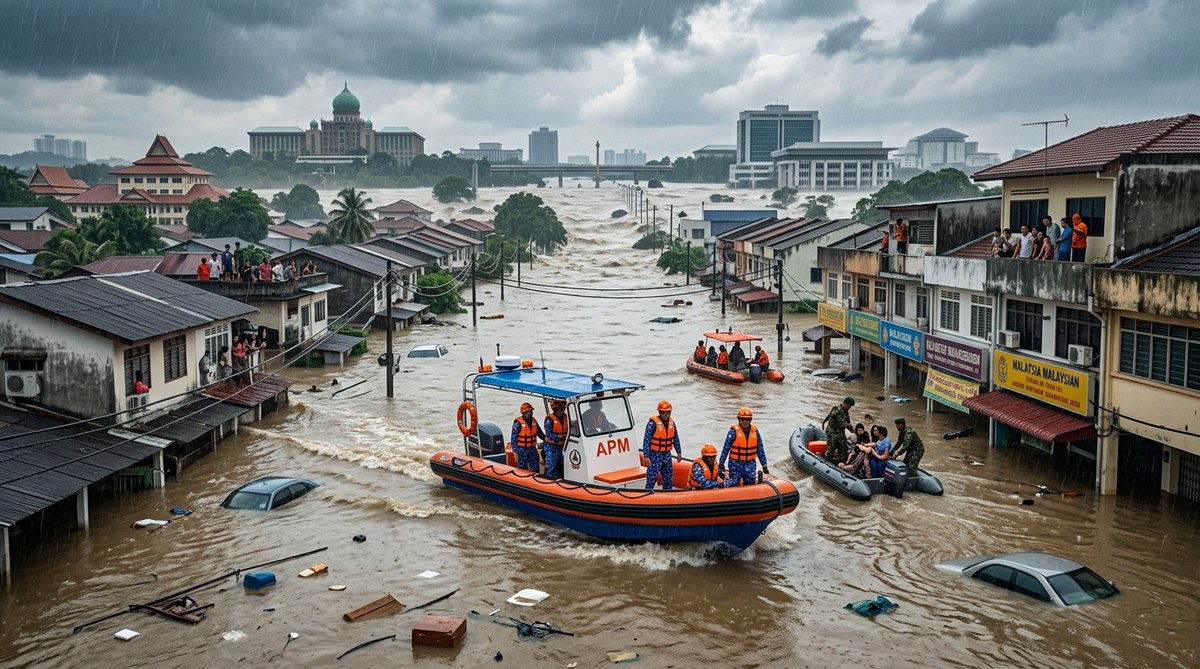
The 2026 monsoon season arrived with a force that caught many off guard. While Malaysians are no strangers to annual floods, the scale and frequency of events this year have pushed federal emergency systems to their limits. From Kelantan to Selangor, evacuation centres are filling up, and the public is asking tough questions about preparedness. The question on everyone’s mind is simple: is the federal response keeping up with the reality of climate change?
Malaysia’s 2026 flood response reveals a system stretched thin. While the National Disaster Management Agency (NADMA) has improved early warning tools, coordination between federal and state agencies remains inconsistent. The 2026 monsoon season has exposed gaps in resource distribution, real-time data sharing, and local capacity building that policymakers must address before the next major flood event.
Why 2026 feels different from past flood seasons
The 2026 flood season is not just another year of heavy rain. Several factors make this season a genuine stress test for the federal response machinery.
First, the weather patterns have shifted. The Northeast Monsoon arrived earlier than usual and brought sustained rainfall over weeks, not days. Rivers in Pahang, Terengganu, and Johor have exceeded danger levels multiple times. Second, urban flooding in the Klang Valley has become more frequent. Areas like Shah Alam and Petaling Jaya, which saw devastating floods in 2021, are again struggling with drainage systems that cannot handle the volume.
Third, the public’s patience is wearing thin. Social media feeds are filled with complaints about delayed救援 and unclear communication from authorities. This pressure is forcing the government to act, but action needs to be smart, not just fast.
How the federal response is structured
Malaysia’s disaster management framework relies on a centralised command system. The National Disaster Management Agency (NADMA) coordinates the federal response. It works with the Malaysian Armed Forces, the Civil Defence Force, the Fire and Rescue Department, and the Social Welfare Department.
Here is how the process is meant to work:
- The Malaysian Meteorological Department (MET Malaysia) issues heavy rain warnings at least 72 hours in advance.
- State disaster management committees activate local operations centres.
- NADMA deploys assets such as boats, four-wheel drive vehicles, and temporary relief supplies to high risk areas.
- The Social Welfare Department opens evacuation centres (PPS) and manages food and basic necessities.
- Post flood assessments are conducted to plan recovery and aid distribution.
In theory, this chain of command should ensure a smooth response. In practice, the 2026 monsoon season has shown that gaps exist between each step.
The coordination challenge between federal and state agencies
One of the biggest lessons from 2026 is that centralised command does not always mean effective coordination. State governments often have better local knowledge, but they depend on federal resources for heavy equipment and funding.
A few common problems have surfaced this year:
- Delays in deploying assets because federal agencies must wait for formal requests from state level.
- Duplication of efforts where both federal and state teams arrive at the same location without a clear lead.
- Mismatched priorities. For example, federal resources may be focused on one district while another district faces a sudden flash flood.
“The 2026 floods have shown that we need a more agile system. Federal agencies cannot wait for paperwork when lives are at stake. We need pre positioned resources and delegated authority at the state level.” Senior disaster management consultant, Kuala Lumpur.
This expert advice points to a need for structural reform. Pre positioning supplies before the monsoon season and allowing state directors to authorise deployments without waiting for Putrajaya could save critical hours.
Technology and data sharing in 2026
Malaysia has invested in technology for disaster management. The National Flood Forecasting and Warning System (PRAB) provides real time river level data. The PublicInfoBencana app shares updates on evacuation centres and road closures.
But the 2026 flood season has exposed some limitations.
| Tool | Purpose | 2026 Performance | Gap |
|---|---|---|---|
| PRAB system | River level monitoring | Generally accurate but some sensors failed during peak flooding | Maintenance and sensor redundancy |
| PublicInfoBencana app | Public alerts and PPS locations | App experienced server slowdowns during high traffic | Scalability under pressure |
| Social media monitoring | Real time public reports | Useful but unverified information caused confusion | Need for official verification layer |
| Drone surveillance | Damage assessment | Used in Kelantan and Terengganu but limited by weather | Weather resistant drone capacity |
The table shows that while the tools exist, they are not always reliable when they are needed most. For policy analysts, the takeaway is clear: investment in technology must include maintenance, redundancy, and stress testing.
What citizens and professionals can do now
For concerned citizens and disaster management professionals, the 2026 flood season offers practical lessons. Here are actions you can take:
- Stay informed through multiple channels. Do not rely on a single app. Follow MET Malaysia, NADMA, and your state disaster unit on social media.
- Prepare a personal emergency kit. Include documents, medication, cash, and essential supplies for at least three days.
- Know your nearest evacuation centre location before the rain starts.
- For professionals, advocate for local disaster response drills. Communities that practise evacuations respond faster.
- Report infrastructure issues like clogged drains to local councils early. Prevention is cheaper than rescue.
The political dimension of disaster response
Disaster response is not just about logistics. It is also about governance and public trust. The 2026 flood season has become a political talking point. Opposition leaders have criticised the federal government for slow action in states where they do not hold power.
This dynamic is not new, but it has intensified. For example, when floods hit Kedah and Kelantan, state governments complained that federal assets arrived later than promised. In contrast, Selangor, which has its own disaster management unit, managed a more coordinated response despite higher population density.
Understanding these dynamics is important for anyone following Malaysia’s political landscape. The way the government handles the flood crisis could influence voter sentiment in upcoming by elections. You can read more about this in our analysis of how Malaysia’s political landscape is being reshaped by the cost of living crisis.
Building resilience beyond 2026
The 2026 monsoon season is a warning, not a final verdict. Malaysia has the resources and expertise to build a world class disaster response system. But that requires moving from reactive to proactive management.
Key priorities for the next year should include:
- Upgrading drainage infrastructure in urban areas, especially in the Klang Valley.
- Establishing permanent regional disaster response hubs outside of Putrajaya.
- Training more local volunteers in search and rescue techniques.
- Creating a unified communication protocol between federal and state agencies.
- Investing in climate adaptation research specific to Malaysia’s geography.
These steps will not prevent floods, but they will reduce the human and economic cost when floods come.
What the 2026 flood season means for Malaysia’s future
Every flood season teaches us something. The 2026 season is teaching us that the old ways of responding are no longer enough. Climate change is making weather patterns more extreme. The federal system must adapt or risk losing public confidence.
For policy analysts and disaster management professionals, this is a moment to push for change. For citizens, it is a reminder to stay prepared and hold leaders accountable. The conversation about flood response is not just about water. It is about governance, trust, and the kind of country Malaysia wants to be.
We will continue to track these developments as the monsoon season progresses. If you want to understand how broader political shifts affect disaster policy, our piece on why Malaysia’s parliamentary backbenchers are gaining unprecedented influence in 2026 offers useful context.
Stay safe, stay informed, and let us work together to build a more resilient Malaysia.




Leave a Reply